– published in Redemption, an anthology edited by Charlie Taylor (2021) 
gallivantriloquism\portmanteau of gallivant and ventriloquist\noun
- The habit or state of wandering from one virtual or imaginary place to another by means of mediated travel anecdotes or experiences of others, without actual contact with the geographies in question.
I suppose being there is two times the fun. Or five times. Even ten. But when it comes to travel, nowadays cyberspace is bringing the mountains, the glaciers, the deserts, the tourist attractions, and street views of the world’s largest metropolises to us. Very few places are untouched by it. Very few that can’t be seen or read about by typing a few terms in the Google search bar. The virtual tour of Iceland I recently made on my iMac to prepare for a trip there was so informative, the amount of available information so comprehensive, it was exhaustive. Scrolling through the sites, I couldn’t help recalling my first trips abroad with out-of-date guidebooks and handwritten recommendations from friends, and friends of friends, then touching down in an amazing land and getting around just fine. Now Iceland is a small, sparsely populated landmass between Greenland and Norway. It’s small also compared to the population density and cultural significance of most other countries I’ve traveled to. Yet, as I watched videos of geysers blowing steam and had pilots’ eye views of small planes cruising over volcanoes, as I checked out photos of a remote thermal bath in the Golden Circle and after that clicked along Reykjavik’s streets in 3D, the question continued to come up during those habitual, and often lengthy, surfing stints: did I want to continue filling my head with images and information to the point that the mystery and excitement of exploring a place I’d never been to might be diminished before I got there? And if not that, then lessened to feel it was a return trip I was making instead of a first visit. More than once during my research I was reminded of the conversation early in Jorge Luis Borges’ story “The Aleph,” where the narrator abridges the discussion about modern man he was having with an acquaintance named Carlos Argentino. “’I view him,’ Argentino said with a certain unaccountable excitement, ‘in his inner sanctum, as though in his castle tower, supplied with telephones, telegraphs, phonographs, wireless sets, motion-picture screens, slide projectors, glossaries, timetables…’” At the end of that, the narrator goes on to say that for someone equipped with those, real travel was unnecessary. The technologies of the 1940s might have been different, but Borges saw them having much the same effect the Internet was having on me. The world wide web was my aleph, and I was a gallivantriloquist walking on Vik’s black sand beaches, viewing the Vatnajökull glacier from the back window of a room in the Fosshotel Nupar, swimming in the clear, geothermal pool in Kirkjubæjarklaustur, and eating a plate of lobster tails in the Fjorubordid restaurant in Stokkseyr. I saw myself on a stool in Mikkeller & Friends decorative space drinking a Hverfisgata Pils. I imagined stepping across the Continental Divide on Leif the Lucky’s Bridge on the Reykjanes Peninsula. I waited in line at the red-painted Bæjarins Beztu Pylsur stand in Reykjavik’s center to buy one of their famous lamb-based hot dogs smothered with sweet mustard and crispy fried onion. And after filling my head with all that, and more, what about Iceland would I miss by not going there? Do the simulations of the computer age make actual travel superfluous the way Borges’ narrator thought less sophisticated devices did in his time? Now that I’m back in New York I can say for certain I’ll take biting into a Bæjarins Beztu lamb dog over a picture of one every day of the week. The real thing is many times better.
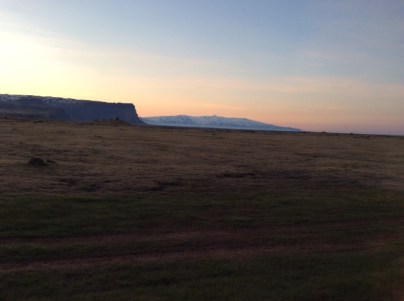
3am view taken by me of the Vatnajökull glacier from the back of the Fosshotel Nupar
 Paul Perilli