WORD OF THE DAY

– published in Redemption, an anthology edited by Charlie Taylor (2021) Screen Shot 2021-02-17 at 7.42.51 AM

gallivantriloquism\portmanteau of gallivant and ventriloquist\noun

  1. The habit or state of wandering from one virtual or imaginary place to another by means of mediated travel anecdotes or experiences of others, without actual contact with the geographies in question.

I suppose being there is two times the fun. Or five times. Even ten. But when it comes to travel, nowadays cyberspace is bringing the mountains, the glaciers, the deserts, the tourist attractions, and street views of the world’s largest metropolises to us. Very few places are untouched by it. Very few that can’t be seen or read about by typing a few terms in the Google search bar. The virtual tour of Iceland I recently made on my iMac to prepare for a trip there was so informative, the amount of available information so comprehensive, it was exhaustive. Scrolling through the sites, I couldn’t help recalling my first trips abroad with out-of-date guidebooks and handwritten recommendations from friends, and friends of friends, then touching down in an amazing land and getting around just fine. Now Iceland is a small, sparsely populated landmass between Greenland and Norway. It’s small also compared to the population density and cultural significance of most other countries I’ve traveled to. Yet, as I watched videos of geysers blowing steam and had pilots’ eye views of small planes cruising over volcanoes, as I checked out photos of a remote thermal bath in the Golden Circle and after that clicked along Reykjavik’s streets in 3D, the question continued to come up during those habitual, and often lengthy, surfing stints: did I want to continue filling my head with images and information to the point that the mystery and excitement of exploring a place I’d never been to might be diminished before I got there? And if not that, then lessened to feel it was a return trip I was making instead of a first visit. More than once during my research I was reminded of the conversation early in Jorge Luis Borges’ story “The Aleph,” where the narrator abridges the discussion about modern man he was having with an acquaintance named Carlos Argentino. “’I view him,’ Argentino said with a certain unaccountable excitement, ‘in his inner sanctum, as though in his castle tower, supplied with telephones, telegraphs, phonographs, wireless sets, motion-picture screens, slide projectors, glossaries, timetables…’” At the end of that, the narrator goes on to say that for someone equipped with those, real travel was unnecessary. The technologies of the 1940s might have been different, but Borges saw them having much the same effect the Internet was having on me. The world wide web was my aleph, and I was a gallivantriloquist walking on Vik’s black sand beaches, viewing the Vatnajökull glacier from the back window of a room in the Fosshotel Nupar, swimming in the clear, geothermal pool in Kirkjubæjarklaustur, and eating a plate of lobster tails in the Fjorubordid restaurant in Stokkseyr. I saw myself on a stool in Mikkeller & Friends decorative space drinking a Hverfisgata Pils. I imagined stepping across the Continental Divide on Leif the Lucky’s Bridge on the Reykjanes Peninsula. I waited in line at the red-painted Bæjarins Beztu Pylsur stand in Reykjavik’s center to buy one of their famous lamb-based hot dogs smothered with sweet mustard and crispy fried onion. And after filling my head with all that, and more, what about Iceland would I miss by not going there? Do the simulations of the computer age make actual travel superfluous the way Borges’ narrator thought less sophisticated devices did in his time? Now that I’m back in New York I can say for certain I’ll take biting into a Bæjarins Beztu lamb dog over a picture of one every day of the week. The real thing is many times better.
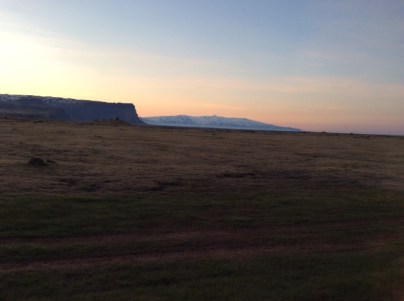
iceland - 3 a.m.

3am view taken by me of the Vatnajökull glacier from the back of the Fosshotel Nupar

NOVELLA EXCERPT: from THE BUS TO ROSLYN

I sense my good fortune, my excitement at doing something on my own even more when I’m down in the big cushioned seat.

I couldn’t have known, I didn’t know, I only sense, at seventeen, what the summer will bring. I only know that on the bus I’m detached from the life I’ve lived so far. I omit it from the present so I’m free, as if nothing existed before. As if everything from myself is loosened from it, removed from myself. So it’s during this ride to Cape Cod, to Roslyn, in that summer, that I feel I’m leaving all that behind.

——–

It’s morning. Eight o’clock. June 14th. He’s in the car his father drives that takes him to the Greyhound station. He’s going to Cape Cod for the summer. He has a job there. He’ll be staying with his aunt and uncle, his cousins Bobby and Susan. He’ll be working at the driving range at Roslyn Country Club where Bobby’s a top caddy. He’ll fill buckets for the members, drive the tractor with the reaper behind it that scoops up balls, make sure members sign the form so they’ll be charged, and he’ll keep his mouth shut too, as his parents have told him he better.

His parents are worried though. They think it’s good he’s doing this. They think it’s bad. All the way from Felton to Back Bay they tell him how they expect him to act. How he has to do everything Uncle Bill and Aunt Doris tell him to do. How he has to help out with the dishes and the cleaning and other chores. How he has to use his own money to pay his way. How he has to get in early. How he has to be nice to Bobby and Susan. How he has to do his own laundry and make his bed every morning.

His mother sums it up, “Act the right way. Mind your manners. Don’t be like you are at home.”

He listens. He repeats. He agrees with everything. Since he’s leaving it’s easy to do this without coming back with a flip comment.

——–

The morning’s warm, the brilliant sun low in the blue sky. It hits on the windshield so his father has to lower the visor.

——–

The bus is almost full. Almost, but not all. I have two seats in the back to myself, the ones across the aisle and one row up from the bathroom, that even with the door closed has a sour smell I don’t like. But after a while I ignore it. It’s worth it if I don’t have to sit beside anyone. If I don’t have to feel I have to talk to them. In my backpack I have a book and paper bag of food, but I don’t take them out. I let my mind drift. I look out at the houses and buildings and streets. Then come the suburbs. By the time we’re in them the bus is going full speed. There’s no more braking and shifting. No more jerks and stops. No more hiss of the air brakes. Right behind me the engine hums at a high pitch.

——–

I see the younger image in the female doctor coming at me in the green hospital smock. She’s seventeen, just as I was. She’s with her father. They’ve come to the driving range. She’s pretty, with blonde hair and sunflower-yellow shorts. A skinny girl, a smooth tan on her face, arms and legs, a high voice. Her father’s tall, with broad shoulders. His brown-and-silver hair’s brushed to one side. When he smiles he shows all his teeth.

He’s dressed to play a round of golf, in a green knit jersey with a small, darker green alligator on the breast, creased tan pants of a light material, a two-tone belt, brown and gray, black and gold shoes. I give him a large bucket. He’ll use half to practice his driver and half for his irons; I know this habit of his already. He takes a dollar out of his pocket, the only one that was there as if it was ready for me. Then he goes to the far end of the tees where the grass is scuffed more than it is closer to the gray shed with the bin of striped balls and wire buckets and myself in. Where there’s a stool for me to sit on and through the open window look out at the members taking their swings.

The far end is where members practice their irons. Dr. Sutherland uses a three or four, I see from the low trajectory of the balls he hits. I position myself on the stool so I’m able to see his daughter sitting under the elm tree that shades the Halfway Shack. She reads a book. It’s the third time since I started that she’s come with him. She’ll leave soon, to go to the Clubhouse to swim or play tennis on the clay courts, and after that, well, after that I can only imagine what someone like her does all day.

I’m stealthy. I look at her only when I see she’s concentrating on the book. We haven’t talked. I don’t talk to the members unless they talk to me. Not even to their children. Especially not to them. Bobby told this to me. And Uncle Bill hinted at it. They’re like my coaches letting me in on the game plan. That’s the way the caddies act, and the way the driving range boy is supposed to too. Don’t speak unless spoken to, and I’m too afraid to say anything anyway.

The girl on the bench rakes her fingers through either side of her hair to loosen it from her temples. The color I see in the hospital only suggests it was blond. The look in her eyes is the same, though. An inquisitive look. A look of knowing more than you do. A look that sees below surfaces. That finds symptoms that aren’t evident to the untrained eye. A doctor’s detached look.

——–

Did she see the boy of seventeen or the man of forty-four? Did she go back to the driving range as I did? Or did she only wonder what brought me there? Was it an ill family member or a friend? Did she see the awkwardness I felt at still feeling like the boy I was then?

“It is you,” she said. “I knew right away.”

“So did I, of course. How have you been?”

She was in a hurry. She had to get to the O.R. Here’s her number. Call her tonight, anytime past seven.

——–

The morning’s bright. The sun burns on the windows and his eyes. But it doesn’t divert them. He looks at the landscape through a squint. He looks but he doesn’t project language on objects. He doesn’t define. He stays within himself. The early summer sun highlights everything. No, it’s late spring he reminds himself. June 14th. Summer starts on the 21st.

The sound of the engine behind him. The powerful force of its pistons pushes the bus forward, toward Roslyn where his cousin and aunt will pick him up, where the summer will begin when he gets there, where his job at the driving range starts in two days.

The voices of two men, two men who don’t know each other, are talking three rows ahead. They pause for a few moments then start up again. He’s not interested in what they say. They’re more like the noise of the engine, a noise that’s there when he stops to recognize it.

The bus moves ahead, carrying him to that place, to Deborah. Everything’s lining up to converge there, to that place where she is. He only knows that something awaits him. The freedom and experience, and lots of fun, he hopes. But right then he’s suspended in his seat, looking out the window, squinting into the glare of sun.

——–

The world’s out there. He hasn’t seen much of it. Yet already he has a feeling for it. The feel of all of it at once and himself in it.

(2001)