My travel piece “Juan Andres’ Collectivo” is published in Coldnoon.
TRAVEL DIARY: THE INSPECTOR GENERAL (CHIAPAS 2000)
With a jolt I awoke to the sudden change of speed. In the middle of the night the bus I was riding in from Oaxaca to San Cristobal de las Casas braked to a stop. The lights over the narrow aisle blinked on as the driver turned in his seat to make an announcement in Spanish, that he repeated in a struggling English.
Men will be coming on, he said. They will only take a moment. After that, we will continue on our way.
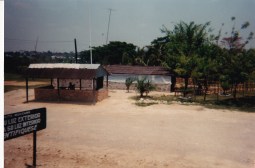
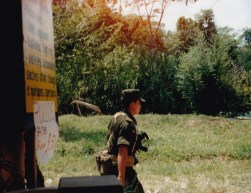
My neighbor in the next seat, a man in his 50s I’d made the evaluation earlier, separated the curtains. We were quiet looking out at the small canopied station of logs and canvas, with a desk a soldier with a camouflage cap on his head sat at. Next to it, two green jeeps and a transport vehicle were parked. More soldiers, I counted six of them, with helmets on their heads and black automatic weapons trained at the ground, stood around a man wearing a white shirt that was tight over his shoulders and pants that had a fine crease in them. Further ahead, a swell in the road had the fluorescent name of the state we were about to enter spray-painted on it.
Chiapas was on the other side and we needed military clearance to pass into it. It was another amendment to my travel guide I’d mention in my notes, a guide that was more like a gloss of reality compared to what I’d been seeing with my eyes. This was one of the checkpoints set up after the 1994 armed uprising that had the intention of stemming the flow of arms and Zapatista sympathizers into the state. Plan Sur was an immigration control program that advanced military occupation along the border.
With an air-compressed whoosh-splash sound the door opened and the man in the white shirt stepped up. He was heavy but not fat, a bulk that exuded strength. Someone, it appeared, who wouldn’t be shy about using the authority he’d been given to prove there was reason his superiors had entrusted him with it. In the third row of seats I read the photo ID hanging from his neck. The General de Inspector seemed alert despite the early hour, as if he was some extraordinary being who didn’t need sleep. Two young soldiers with rifles came up behind him.
A burst of Spanish with the driver ended with a smile and a laugh. Then the Inspector General started down the aisle in a slow, menacing way, his gaze penetrating the eyes that looked up at him long enough to build a paperless dossier on what he saw in each. He was a believer, I was sure, that eyes would tell you everything. The lawbreakers and anti-government rebels carried a look that would show you they’re covering up the thing you’re looking for. It was his job to find those people wherever they were. Everyone was under suspicion until they weren’t.
The Inspector General checked a few IDs, but not mine. I was a tourist, not a threat, and he must have seen that affiliation on my face. The affiliations of my fellow riders showed they weren’t rebels or lawbreakers either.
Reaching the back, the soldiers about-faced and came up the aisle. The Inspector General came up behind them. He was done with our bus. And that was the meaning of Plan Sur, to get the word moving around: Don’t dare fuck with us or you’ll be caught and arrested.
At the front, the Inspector General and the driver exchanged another burst of Spanish. After that, the Inspector General nodded and stepped down. The driver waved. The door closed, the lights went off and there was a shift of gears. The bus continued along the dark highway toward San Cristobal.
I did as my neighbors. I closed my eyes and tried to get back to sleep.
Plan Sur

(2000)
THE CURE THAT ALES YOU (YOUR SPELL CHECK IS COMPLETE)
– published in The Offbeat, volume 18, 2017 (defunct) 
– all lines are spell check “misunderstandings” found in my mss
In hefty potions
They had greed on that too
To keep the boos happy
Noting they could do
A soar loser
Ever herd of one
Made dinner for her bothers
They beast each other up
A hard-noosed area
Boast people on the sea
The remnant he was charging
Wasn’t ass appealing
Back and froth talk
He hit the break for sure
With a pale of gray water
He sighed on for a second tour
Have to remain clam
It swept overt you
Led to the off ice
To hire someone knew
Her hick pink lips
She put pout there
At pone time
First I’ll come my hair
He waned to come to my place
To draw a deep breather
Three days and tow nights
It wend on for many weeks
Big wood hopping block
One of the moist exotic
He put it on the tablet
He knew that mush about it
The variety stories
Twenty years older than her souse
Listing to jazz
It all pained out
With his hand son the keyboard
He trued a few sites
A lick of the mouse button
Brought it hoe that night
Sitting in the soft char
To see photos of my trip to Pairs
He issued his replay
Which cured all his ales
NEWS:
Two pieces I wrote while traveling in Oaxaca appear in Coldnoon.
NOVEL IN PROGRESS: from CAMPUSES
Each time I went to the campus on the hill to be in the orbit of those students I let my imagination wander into their lives. The more I did the more I couldn’t wait to be one of them, to be as free, to no longer feel I was being observed as if I was in a prison I wouldn’t ever be released from, not even for good behavior.
Soon enough I was on my own campus, and once I was there it didn’t take long to figure out college life wasn’t all partying and protesting and hitting on the girls I couldn’t keep my eyes off of. And while it might have been freedom, more freedom than I’d ever had, it was a different sort than I’d anticipated. I’d been released from the jail cells on Eddy Street and Felton High to become a captive of those courses I’d registered for with that humored Teaching Assistant. My days became great efforts to divvy up the time to give to each of them.
How many hours to spend on the first two Books of the Iliad? How long would it take to reread the chapter on Hegelian idealism until I was confident enough to be tested on it? Just what did I think about social structures and stratifications and normative behavior patterns? Where should I start the essay about going to McGovern’s speech on that clear, crisp afternoon when I heard the rapid-fire clicks of that photographer’s camera and wondered if I’d end up on the front page of The Globe?
The whole experience overwhelmed. The orderly way I went about my studies at Felton, the ease I got A’s on tests and papers with, became a labor with no end point, a profusion of words and ideas and themes I organized as best I could in notebooks and 4×6 index cards I filed in a gray metal box that flipped open at the top. I kept checklists of things done and things to do and some of the things that were done would become items on those lists again. I reviewed notes in bathroom stalls. I highlighted important paragraphs I went back to to keep them fresh in my head. It was so consuming it was impossible to find time to break away from those stacks of hardbound texts and trade paperbacks and clips of loose-leaf pages and manila file folders that cluttered the three drawers of my desk and the shelves above it without the feeling I was ignoring something important, or I hadn’t got to something at all. Or the moment I thought I was in control an assignment would crop up that I’d struggle with two or three nights in a row to the detriment of everything else.
In the library, that charmless, U-shaped building smack in the center of campus, I worked like a drone at my favorite desk on a remote aisle on the lower level. Half below the street and half above it, a faint, grayish light seeped in the small windows. But it was the atmosphere I preferred to do my heavy duty booking in, an environment suited for the fierce undertaking required to process all of that knowledge. That featureless space was as comforting to me as the carrel deep in the belly of the learning beast I went to in Felton, and I was aware how I’d transferred the image of that to my own campus.
I settled in there four or five hours at a time, my squinting eyes rolling across and down the lines of text, a pen jotting notes in a loose leaf binder. I moved from The Inferno to The Canterbury Tales to a chapter on medieval social thought and back in time from there to Hellenistic Greece and around to each of them again the next night until another book or topic or the introduction of some new material replaced them and the juggling of texts and notebooks started over. It was rare for me to take a break for fear I might never get back to my work. There were plenty of distractions to run into on the upper levels. Plenty of friends to chat with and chicks with big smiles to sit near and sneak looks at and do nothing else. But most of the time I was able to avoid that until I crossed the avenue and got back to the dorm where the hallways would be abuzz, the doors to the rooms open, the laughter exploding off the cinderblock walls. More often than not I’d catch a whiff of marijuana, and if it were the weekend my nose would tweak in expectation of scoring a bone or two for the night. That was another way to relax.
That Thursday it took a few minutes to get through the gauntlet of “hey man, what’s happening” and “there he is, ready to rock” to get to the far end of the hall where I keyed the lock to room 324. When I opened the door I was surprised to find Willie sprawled on his bed with his head propped up by two bolsters; I had expected he would be out with his girlfriend Gail, an amiable red head studying biology. But there he was, reading a book titled Political Philosophy he used both hands to hold open. Sophomore year, we shared that boxy space with the view over the walkways and the grassy knoll known as “The Beach,” which we occupied by the hundreds when the weather was warm enough to sit out and chat and flirt and fling a Frisbee around. To do anything for a while but study.
Willie was tall and athletic, with a head of light, bushy hair. He was from a big Irish family on Long Island, New York, a family that, except for its larger size, was a lot like my own in that there wasn’t a lot of money and they didn’t want him to go to the war. I suppose those were good enough reasons to dump our freshman year roommates to share that space together. An obsession with basketball and our budding radicalism were two others.
Willie wore denim shirts and thick-soled construction boots and heavy hooded sweatshirts, though he was in a t-shirt and barefoot that night in our room.
“It’s a circus out there.” I kept my hand on the door knob.
“Leave it open. Time to put this down and let it come to us.”
“Or to let you out to join it is more like it.”
“How’d it go over there?”
“Went as usual. Kicked serious ass. Got everything I needed to done.”
“You mean everything except for that.” The quick flip of his head brought attention to my desk, where half a page of writing was scrolled in my portable Olivetti. I scanned the first few lines of that work-in-progress about hearing McGovern’s speech on the Boston Common. The speech when he made the claim to be tired of gray-haired men sending young people to a war they wouldn’t let their own children go to.
“Tell me, huh, what do you think of that shit?” The Captain had looked at me after he’d said it.
I was impressed, deeply impressed, I’d neglected to tell him and had just smiled instead. Yet, he must have seen I was moved by it from the look of amazement I felt glowing on my face.
The essay would have to be done by Tuesday, and while I had a couple of paragraphs on paper and thousands of words more about it bouncing around my head, I had to fit them all onto two white sheets in a shape that would impress my teacher. I was hoping the rest would come without too much brain strain, or retyping, a painstaking labor I might have to use half a bottle of white-out and lot of manipulation of the paper and release lever to get the revised words aligned in the right places. I was hoping, but typing wasn’t easy for me.
Willie went to his desk and fussed with a pouch of Drum tobacco and a folder of E-Z Wider papers and his cheap pocket-sized Zig Zag cigarette roller. At last he had the tobacco packed just right and he tamped an end down on the desk and used his other hand to dig into his pocket. A thumb struck the silver lighter that made a crisp, satisfying click when he snapped it closed. Thursday night, 9:30, I was antsy to get out, and with the instinct of a homing pigeon Willie knew where I wanted that to be.
“I know you’re thinking you should be drinking at Dixon’s,” he said. A few puffs of residual smoke leaked from his nostrils.
“Picking up Gail on the way?”
“Gonna book. No distractions, she told me. No sugar tonight in my coffee.”
“Well, let us gather the proper documents in case this is the night Mr. D. decides to card us,” I said.
“Never happened. Only paperwork Mr. D. wants to see from us are green on both sides.”
“Still got to have the appropriate identification should The Man come a calling.”
“And the Man’s not calling on Dixon’s unless a white person’s stabbed in there, and more than one.”
“Right-o there, dude. I’m sure it’s happened once or twice. But let’s just go way out in deep space and say The Man does make a visit, he ain’t believing a word on this anyway.” I flashed the fake, though professionally produced, laminated I.D. card me and half of the campus had scored at Beta House for twenty bucks a pop. It was in my back pocket as Willie and I headed for the elevators and went out into the darkening night.
The weather was warm, one of the last mellow nights before the chilly weather kicked in and the wind that whipped off Lake Michigan stung our flesh and the heavy snows fell for hours at a time and put the city’s streets to sleep. Do I know for certain the weather was warm that night or if it was the last temperate day of the year? Or was there a rich, cool autumn breeze in the air? I’m not sure, so I went with the former. And why not? Except for a few surface effects and an embellishment here and there, none of this is made up. What happened is all true, so why not say it was warm outside as we started across the walkways and kept up a quick pace, past the lit windows of the big rectangular-shaped dorm across from ours, where a female shadow passing by a closed window caught my eye, and through an open crack in one next to it my ears filtered out all other sounds as the ding ding ding of a telephone rang out. Soon the Administration Building was behind us and we were on the sidewalks of the North Side with their squalid addresses and dark, grim alleys. It was a neighborhood where all the other lives lived out of public attention. Each walk through it prompted Willie and I to talk about doing anything we could to undermine capitalism, an ideology that accepted the crushing of a thousand for each one it rewarded.
“It ain’t no friend of mine or anyone’s around here,” Willie said.
“Ain’t no friend to any of us at all,” I said to keep the drift going.
“And if it ain’t a friend then it must be an enemy.”
“Right on. If it don’t like us why should we like it?”
“Don’t mean a flying fuck to me.”
“Free enterprise is free for some. Ain’t for just anyone.”
“You’re a poet and you know it.”
“That I am, but I’m no Uncle Sam.”
(2013)
NEWS:
My piece Trumped! is forthcoming in volume 4 of the The Transnational.
 Paul Perilli